ChatGPT vs Google: what AI changes in how people search for information
Is ChatGPT replacing Google? What the NBER study “How People Use ChatGPT” reveals, and how an SME should adapt its SEO to be cited by AI.
Updated on
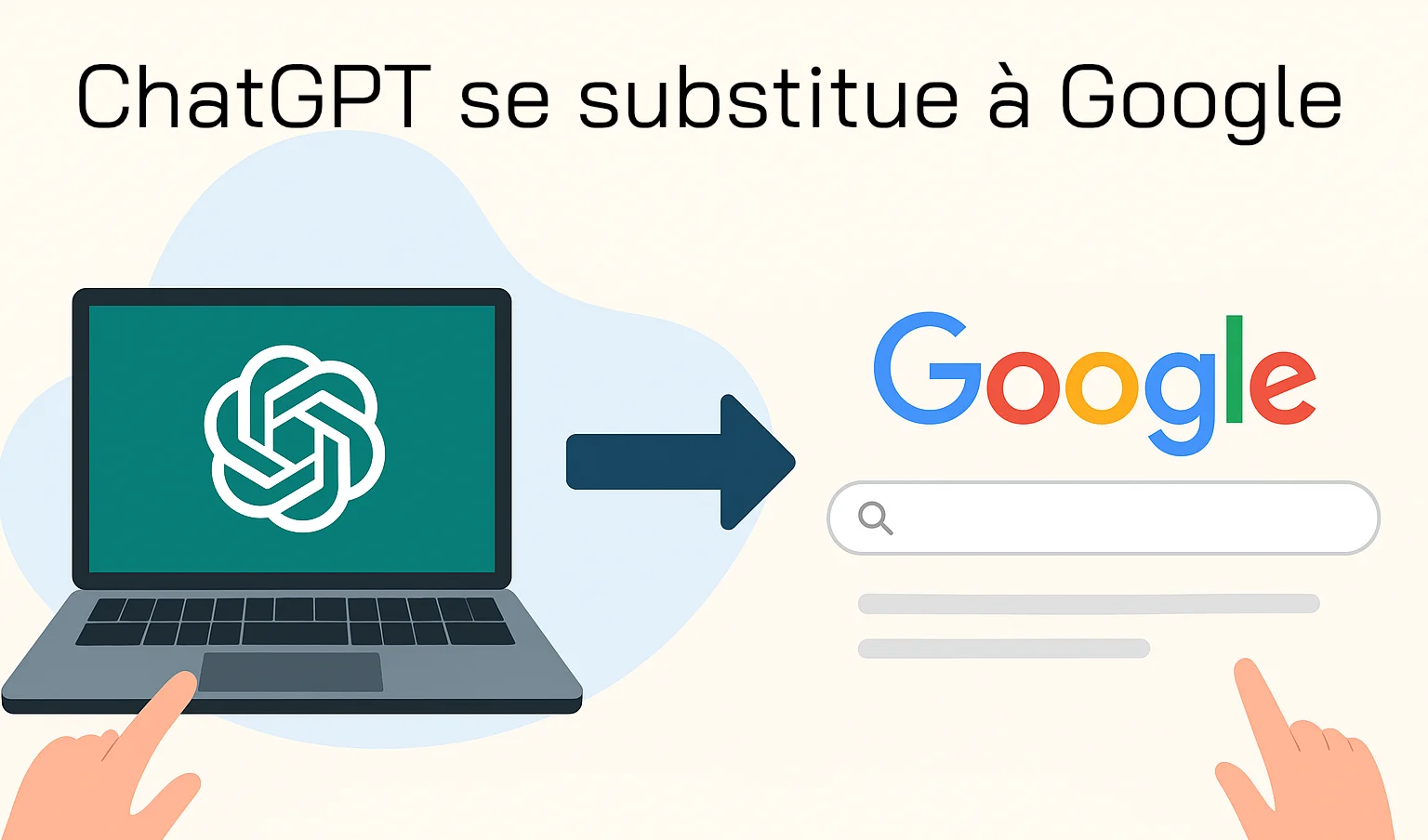
In September 2025, researchers from OpenAI and several universities published a study titled How People Use ChatGPT with the NBER (National Bureau of Economic Research). It is the first large-scale analysis of how ChatGPT is actually used, based on more than a million anonymised conversations. I read it here with an SEO practitioner's question in mind: what does this change for an SME's visibility?
Unprecedented adoption
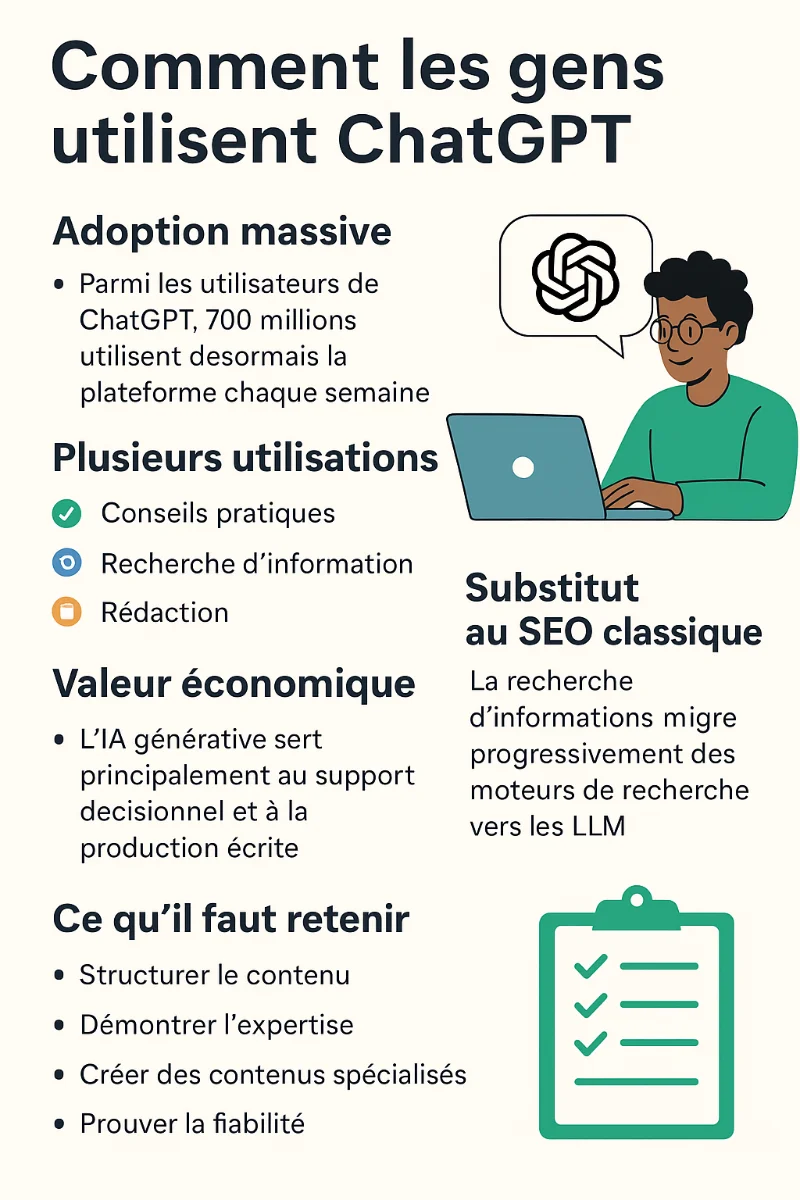
In July 2025, ChatGPT was used by around 10% of the world's adult population, some 700 million people every week, who sent 18 billion messages. No digital tool had ever been adopted so quickly.
The study also notes that personal use has overtaken professional use: messages unrelated to work rose from 53% to more than 70% of the total. ChatGPT is therefore no longer an office tool; it is an everyday reflex, as the search engine once was.
What people really ask ChatGPT
Three broad topics account for nearly 80% of conversations:
- Practical Guidance: tutorials, explanations, recommendations tailored to a situation.
- Seeking Information: the direct equivalent of a Google query.
- Writing: drafting, rewording, translating, summarising.
Conversely, programming accounts for only 4.2% of messages, far less than is often assumed.
Asking, Doing, Expressing: three intents
The study also classifies messages by user intent:
| Intent | Share of messages | Example |
|---|---|---|
| Asking | 49% | "Which accounting software should an SME choose?" |
| Doing | 40% | "Write a reminder email to this client." |
| Expressing | 11% | Personal reflection, conversation |
In a work context, 56% of messages are "Doing", with writing making up the largest share.
Key point: "Asking" messages are exactly the queries that, a few years ago, went through Google. That is where a business's visibility in AI is decided.
Is ChatGPT replacing Google?
No, but it is taking part of its role. Open questions, comparisons and requests for advice are partly moving to AI assistants, which deliver a synthesised answer instead of a list of links.
Google is adapting too: its AI Overviews, generated answers at the top of the page, reached more than 2 billion users a month in over 200 countries in 2025. Generative search is therefore not only happening in ChatGPT; it is happening in Google as well.
For an SME, the consequence is concrete. When a business owner asks "which provider can automate my invoicing in Geneva?", they increasingly get a written answer that cites two or three names, rather than a page of ten links. Not being one of those names means not existing for that search. AI assistants that rely on external sources work on the principle of RAG: they search first, then write.
How to get cited by AI: what I recommend
Nobody can guarantee a citation by an AI assistant: answers vary with the tool, the wording and the moment. There are, however, practices that clearly increase the likelihood of being picked up.
1. Answer clearly, right from the start
AI engines readily extract a summary placed at the top of a page, a crisp definition or a direct answer to a question. A text that circles the subject for three paragraphs has little chance of being cited.
2. Structure the content
Headings phrased as questions, lists, comparison tables and an FAQ make the page easier to read for a model as well as for a human. I also add structured data (Schema.org) describing the author, the business and the content of each page.
3. Demonstrate verifiable expertise
An identified author, a genuine last-updated date, cited sources, verifiable figures: these are the signals Google groups under the acronym E-E-A-T (experience, expertise, authoritativeness, trustworthiness). Generative engines are just as sensitive to them.
4. Be consistent everywhere
Name, address, activity, description: the business must be described the same way on its website, its Google profile, LinkedIn and directories. An AI that finds contradictory information hesitates to cite you.
5. Stay visible in Google
Generative engines draw heavily on pages that already rank well. Classic SEO remains the foundation: a fast, well-structured website, with pages that precisely answer the right searches. You can check your titles with my SERP simulator (in French).
My view
I don't believe in the end of SEO; I believe in its expansion. The principles that make a good page for Google (answering precisely, proving expertise, being clearly identified) are exactly those that make a source citable by an AI.
What changes is the demand for clarity. A vague, generic or unsigned page loses on both fronts. A useful, structured and signed page wins on both. That is the approach I follow for my clients, working on SEO and GEO in Geneva together.
If you are looking for a provider for this work, here are the criteria for choosing an SEO agency in Geneva, including how to tell whether an independent consultant is enough for your needs.
Useful sources
- Chatterji, Cunningham, Deming, Hitzig, Ong, Shan and Wadman, How People Use ChatGPT, NBER Working Paper No. 34255, September 2025
- Google, Alphabet Q2 2025 earnings call: remarks by Sundar Pichai
- Google Search Central, AI features and your website
- Google Search Central, Creating helpful, reliable, people-first content
Frequently asked questions
What I’m asked most often
- Will ChatGPT replace Google?
- Not in the short term. ChatGPT is capturing a growing share of information and advice searches, but Google remains the main entry point for finding a provider, an address or a product. Google itself also includes AI-generated answers, AI Overviews, which reached more than 2 billion users a month in 2025.
- What is GEO?
- GEO (Generative Engine Optimization) is the work of making a website understandable and citable by generative engines such as ChatGPT, Perplexity or Google's AI Overviews. It relies on clear, structured content, clean structured data and a clearly identified business.
- Is SEO still useful with AI?
- Yes. Generative engines rely largely on pages that already rank well and on sources considered reliable. A technically sound, well-structured and recognised website remains the foundation of visibility, in Google as in AI assistants.
- How can I tell whether ChatGPT cites my business?
- Ask the main assistants the questions your clients would ask, for example “which SEO consultant in Geneva?”, and note who gets cited. Answers vary by tool and over time: repeat the exercise regularly rather than drawing conclusions from a single attempt.

Written by
Thierry Barbezat
Independent consultant in Geneva. Co-owner of an SME for ten years before moving full-time into automation, web design and SEO. CAS in digital communication from the University of Geneva, certified in n8n and Make.
Related articles
- How to choose the best SEO agency in Geneva
How do you choose an SEO agency in Geneva? 8 verifiable criteria, the warning signs flagged by Google, and when an independent consultant is enough.
- Agentic RAG: definition, how it works and use cases
What is agentic RAG? How it differs from classic RAG, how it works, concrete SME use cases, its limits and how to build it with n8n.
- Business automation with AI: what really changes for an SME
Business automation with AI: what it really changes, examples by trade, how to get started and the mistakes SMEs should avoid.
First call, no commitment
Let’s talk about your visibility.
Thirty minutes to look at where you stand, what your clients search for and what you can realistically expect. No ranking promises: nobody can honestly make them.